
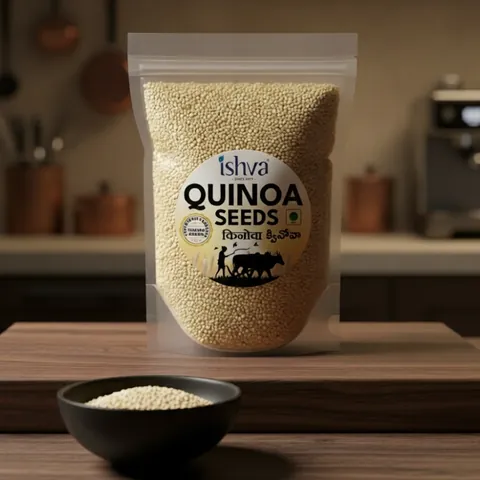
Quinoa Seeds
Chenopodium quinoa · క్వినోవా · किनोवा
VegetarianWhole quinoa seeds in 500 g and 1 kg pouches, packed in Hyderabad. Quinoa is a seed, not a grass grain, but it cooks like a grain.
Quinoa comes from the Andes of Bolivia and Peru, where it has been grown for about 7,000 years; the shores of Lake Titicaca hold its greatest diversity. In 1553 the Spanish chronicler Pedro de Cieza de Leon wrote that the people of Quito made a drink of its seeds and ate them cooked, as we do rice. In 1609 Garcilaso de la Vega gave quinua the second place among the grains grown in Peru. The United Nations declared 2013 the International Year of Quinoa.
Per 100 g of the raw seed, India's food composition tables (ICMR-NIN, IFCT 2017, one regional sample) give 328 kcal, 13.1 g protein, 14.7 g dietary fibre, 198 mg calcium and 7.5 mg iron. It goes into upma, salads, soups, porridge and sweets.
Hear it pour
Our own pack of quinoa, opened and poured into a steel bowl — filmed on a phone, nothing added.
Turn the sound on: the grain has its own sound as it falls.
On the pack
- Ingredients
- Whole Quinoa Seeds
- Shelf life
- Best before nine months from packing
- Storage
- Transfer the contents to an airtight container after opening and store in a cool, dry place. Do not buy a pack that is open, tampered or punctured.
In the Vedic rituals
Quinoa comes from the Andes, so the Vedas do not know it; its own old record is in the Spanish chronicles of Peru (below).
How it was cooked
Vegetarian recipes with quinoa seeds, each shared as its source gives it, with the source named.
- Quinoa UpmaModern · Pan-India · breakfast
- Quinoa TabboulehModern · International · lunch
- Quinoa Salad with Toasted Cumin and Lemon DressingModern · International · lunch
- Quinoa and Pumpkin SoupModern · International · dinner
- Quinoa Burger with Pumpkin and SeedsModern · International · dinner
- Quinoa Crispy BarsTraditional · International · snack
- Spiced Quinoa Porridge with AppleTraditional · International · sweet
- Quinoa Salad with Cheese and ChivesTraditional · International · lunch
- Black Quinoa, Sweet Potato and Plantain SaladModern · International · lunch
- Quinoa and Potato PuréeTraditional · International · lunch
- Quinoa with Roasted Tomatoes, Walnuts and OlivesModern · International · dinner
- Quinoa and Chickpea Stuffed Peppers with MerquénModern · International · dinner
- Sweet Quinoa Kispiña (Steamed Quinoa Flour Bites)Modern · International · snack
- Toasted Quinoa Flour in MilkTraditional · International · breakfast
- Apple Crumble with Quinoa FlakesModern · International · sweet
- Creamy Quinoa Dessert with FruitTraditional · International · sweet
- Quinoa Rocher with Raspberry CentresModern · International · sweet
- Quinoa and Pineapple DrinkTraditional · International · drink
- Quinoa Cooked Like Rice (as described by Cieza de León, 1553)Ancient · Andes (Quito, present-day Ecuador) · lunch
- Quinoa Chicha (Andean Quinoa Drink with Fruit and Herbs)Ancient · Andes (Peru); modern recipe from Ecuador · drink
Nutrition of the grain, per 100 g (raw)
| Nutrient | Amount |
|---|---|
| Energy | 328 kcal |
| Protein | 13.11 g |
| Fat | 5.5 g |
| Carbohydrate (available) | 53.65 g |
| Dietary fibre (total) | 14.66 g |
| Calcium | 198 mg |
| Iron | 7.51 mg |
| Magnesium | 119 mg |
| Phosphorus | 212 mg |
| Zinc | 3.31 mg |
Source: Indian Food Composition Tables 2017, ICMR-National Institute of Nutrition · food code A009 (Quinoa), one regional sample. Energy converted from the tables’ kJ (1 kcal = 4.184 kJ). Published values for the grain, not a laboratory test of this pack.
Questions people ask about quinoa seeds
Is quinoa a millet?
No. Quinoa is the seed of Chenopodium quinoa, a plant of the amaranth family; millets are grasses. It is cooked and eaten like a grain, which is why it is often shelved with millets. (FAO / PROINPA 2011, Quinoa: an ancient crop)
What is the difference between quinoa and millets?
Quinoa comes from the Andes of Bolivia and Peru; foxtail, kodo and little millet are grasses grown in India for thousands of years. Per 100 g raw, quinoa has 13.1 g protein and 14.7 g dietary fibre, kodo millet 8.9 g and 6.4 g, little millet 10.1 g and 7.7 g (Indian Food Composition Tables 2017; quinoa from one regional sample). (Indian Food Composition Tables 2017, ICMR-National Institute of Nutrition)
What is the nutrition of quinoa per 100 g?
Per 100 g of the raw seed: 328 kcal, 13.1 g protein, 14.7 g dietary fibre, 53.7 g carbohydrate, 5.5 g fat, 198 mg calcium and 7.5 mg iron (Indian Food Composition Tables 2017, code A009, one regional sample). (Indian Food Composition Tables 2017, ICMR-National Institute of Nutrition)
How do I cook quinoa seeds?
Soak it for a couple of hours, then simmer 1 cup of quinoa in 3 cups of water, covered, for about 15 minutes. (FAO, International Cookbook for Quinoa (2014))
Is quinoa gluten-free?
Yes. Quinoa is naturally gluten-free.
Where does quinoa come from?
From the Andes of Bolivia and Peru, where it has been grown for about 7,000 years; the shores of Lake Titicaca hold its greatest diversity. Ishva packs it in Hyderabad. (FAO / PROINPA 2011, Quinoa: an ancient crop)
What does Ishva Quinoa Seeds cost?
MRP on the pack: 500 g ₹230, 1 kg ₹450. On the DMart shelf in November 2026: 500 g ₹115, 1 kg ₹225; store offers change from day to day.
Where can I buy Ishva Quinoa Seeds near me?
At DMart stores in Telangana and Andhra Pradesh: 84 DMart stores list Ishva Quinoa Seeds. Enter your PIN code on this page to find the nearest one.
How long does a pack keep?
Best before nine months from packing. After opening, move the grain to an airtight container and keep it in a cool, dry place.
Compared with rice and wheat, per 100 g
| Grain | Energy kcal | Protein g | Fibre g | Carbs g | Fat g |
|---|---|---|---|---|---|
| Rice, white (milled) IFCT 2017 A015 | 356 | 7.9 | 2.8 | 78.2 | 0.5 |
| Wheat flour (atta) IFCT 2017 A019 | 320 | 10.6 | 11.4 | 64.2 | 1.5 |
| Kodo millet IFCT 2017 A017 | 332 | 8.9 | 6.4 | 66.2 | 2.6 |
| Little millet IFCT 2017 A016 | 346 | 10.1 | 7.7 | 65.6 | 3.9 |
| Quinoa IFCT 2017 A009, one regional sample | 328 | 13.1 | 14.7 | 53.7 | 5.5 |
| Foxtail millet ICMR-NIN 2018 via APEDA; not in IFCT 2017 | 331 | 12.3 | — | 60.9 | — |
Per 100 g of the raw grain. Energy converted from the tables' kJ (1 kcal = 4.184 kJ). Published values for each grain, not a laboratory test of a pack. Sources: Indian Food Composition Tables 2017, ICMR-National Institute of Nutrition; foxtail millet: APEDA Millet Portal, foxtail millet (values from ICMR-NIN 2018).