
Quinoa
Chenopodium quinoaPictures
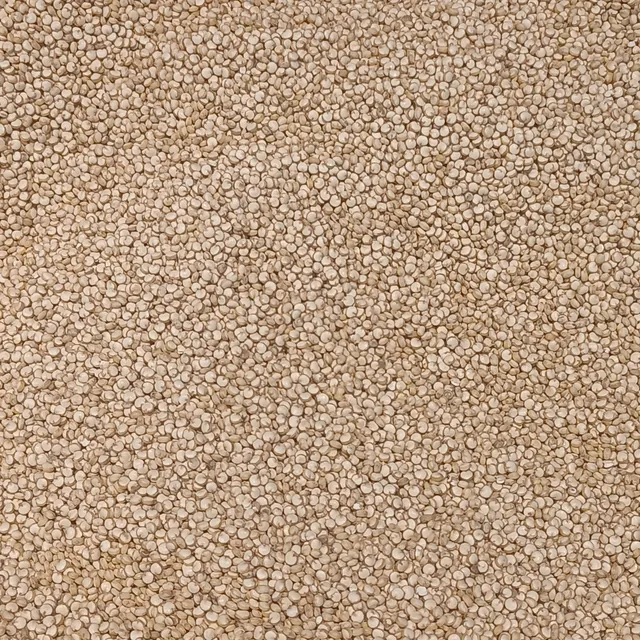
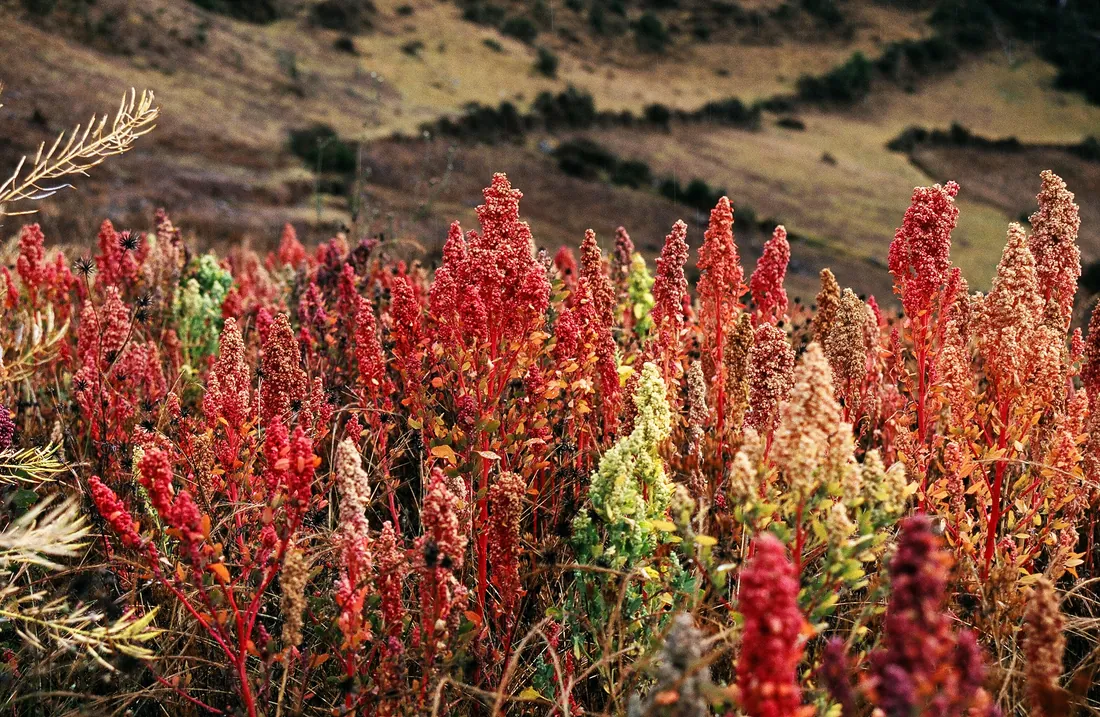
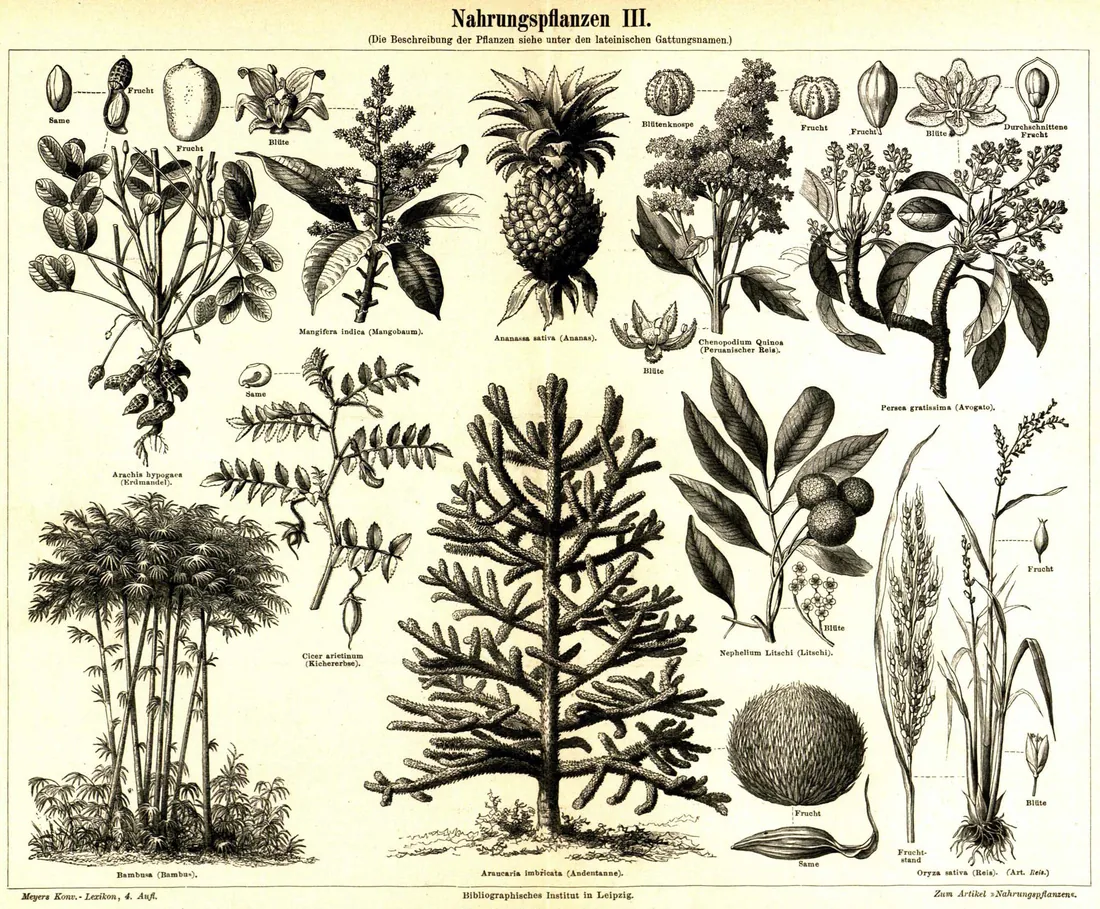
Hear it pour
Our own pack of quinoa, opened and poured into a steel bowl — filmed on a phone, nothing added.
Turn the sound on: the grain has its own sound as it falls.
Nutrition of the raw grain, per 100 g
| Energy | 328 kcal |
| Protein | 13.11 g |
| Fat | 5.5 g |
| Carbohydrate (available) | 53.65 g |
| Dietary fibre (total) | 14.66 g |
| Calcium | 198 mg |
| Iron | 7.51 mg |
| Magnesium | 119 mg |
| Phosphorus | 212 mg |
| Zinc | 3.31 mg |
Source: Indian Food Composition Tables 2017, ICMR-National Institute of Nutrition, food code A009 (Quinoa), one regional sample. Energy converted from kilojoules (1 kcal = 4.184 kJ).
Every nutrient in the raw grain — 95 values, per 100 g
Energy, protein, fat, carbohydrate, fibre9
| Water (moisture) | 10.43 g |
| Protein | 13.11 g |
| Ash (total minerals) | 2.65 g |
| Fat | 5.5 g |
| Dietary fibre (total) | 14.66 g |
| Insoluble fibre | 10.21 g |
| Soluble fibre | 4.46 g |
| Carbohydrate (available) | 53.65 g |
| Energy | 1374 kJ |
Starch and sugars4
| Available carbohydrate (starch + sugars) | 49.82 g |
| Starch | 48.41 g |
| Glucose | 1.41 g |
| Free sugars (total) | 1.41 g |
Not detected in this grain (the table leaves it blank or zero): Fructose, Maltose, Sucrose.
Minerals5
| Calcium | 198 mg |
| Magnesium | 119 mg |
| Phosphorus | 212 mg |
| Potassium | 474 mg |
| Sodium | 4.5 mg |
Trace elements6
Not detected in this grain (the table leaves it blank or zero): Cobalt, Molybdenum.
Vitamins12
| Thiamine (B1) | 0.83 mg |
| Riboflavin (B2) | 0.22 mg |
| Niacin (B3) | 1.7 mg |
| Pantothenic acid (B5) | 0.62 mg |
| Vitamin B6 | 0.21 mg |
| Biotin (B7) | 0.62 µg |
| Folate (B9) | 173 µg |
| Vitamin E: alpha-tocopherol | 2.08 mg |
| Vitamin E: beta-tocopherol | 0.06 mg |
| Vitamin E: gamma-tocopherol | 2.85 mg |
| Vitamin E (alpha-tocopherol equivalents) | 2.39 mg |
| Vitamin K1 | 2 µg |
Not detected in this grain (the table leaves it blank or zero): Vitamin D2 (ergocalciferol), Vitamin E: alpha-tocotrienol, Vitamin E: delta-tocopherol, Vitamin E: gamma-tocotrienol.
Carotenoids4
| Lutein | 11.88 µg |
| Zeaxanthin | 10.05 µg |
| Beta-carotene | 5.12 µg |
| Carotenoids (total) | 153 µg |
Amino acids18 · g per 100 g of protein
| Histidine | 2.98 g |
| Isoleucine | 3.75 g |
| Leucine | 6.08 g |
| Lysine | 5.55 g |
| Methionine | 2.24 g |
| Cystine | 1.85 g |
| Phenylalanine | 4.35 g |
| Threonine | 3.01 g |
| Tryptophan | 1.25 g |
| Valine | 4.55 g |
| Alanine | 4.35 g |
| Arginine | 7.85 g |
| Aspartic acid | 8.4 g |
| Glutamic acid | 13.75 g |
| Glycine | 4.8 g |
| Proline | 5.67 g |
| Serine | 4.56 g |
| Tyrosine | 1.98 g |
Fatty acids11
| Myristic acid (C14:0) | 82.76 mg |
| Palmitic acid (C16:0) | 434 mg |
| Stearic acid (C18:0) | 52.88 mg |
| Myristoleic acid (C14:1) | 44.41 mg |
| Palmitoleic acid (C16:1) | 56.79 mg |
| Oleic acid (C18:1) | 1323 mg |
| Linoleic acid (C18:2, omega-6) | 2203 mg |
| Alpha-linolenic acid (C18:3, omega-3) | 204 mg |
| Saturated fat (total) | 570 mg |
| Monounsaturated fat (total) | 1424 mg |
| Polyunsaturated fat (total) | 2406 mg |
Not detected in this grain (the table leaves it blank or zero): Arachidic acid (C20:0), Behenic acid (C22:0), Capric acid (C10:0), Eicosenoic acid (C20:1), Erucic acid (C22:1), Lauric acid (C12:0), Lignoceric acid (C24:0).
Organic acids6
| Oxalate (total) | 82.94 mg |
| Oxalate (soluble) | 42.22 mg |
| Oxalate (insoluble) | 40.72 mg |
| Fumaric acid | 25.07 mg |
| Malic acid | 0.23 mg |
| Succinic acid | 2.07 mg |
Not detected in this grain (the table leaves it blank or zero): Citric acid, Quinic acid, Tartaric acid, cis-Aconitic acid.
Polyphenols16
| 3,4-Dihydroxybenzoic acid | 6.7 mg |
| 3-Hydroxybenzaldehyde | 0.44 mg |
| Protocatechuic acid | 9.7 mg |
| Vanillic acid | 4.9 mg |
| Cinnamic acid | 0.11 mg |
| o-Coumaric acid | 0.02 mg |
| Caffeic acid | 0.13 mg |
| Apigenin-7-O-neohesperidoside | 0.13 mg |
| Luteolin | 0.19 mg |
| Kaempferol | 3.6 mg |
| Quercetin | 1.9 mg |
| Quercetin-3-glucoside | 3.4 mg |
| Quercetin-3-rutinoside (rutin) | 4.4 mg |
| Quercetin-3-galactoside | 4.3 mg |
| Sinapic acid | 65.72 mg |
| Polyphenols (total) | 74 mg |
Not detected in this grain (the table leaves it blank or zero): Apigenin, Catechin, Chlorogenic acid, Ferulic acid, Gallic acid, Isorhamnetin, p-Coumaric acid.
Phytosterols3
| Campesterol | 0.91 mg |
| Stigmasterol | 1.89 mg |
| Beta-sitosterol | 46.1 mg |
Other compounds1
| Phytate | 120 mg |
Not detected in this grain (the table leaves it blank or zero): Raffinose, Saponins (total), Stachyose.
Source, one for the whole list: Indian Food Composition Tables 2017, ICMR-NIN. Values exactly as the table prints them; published values for the grain, not a laboratory test of our packs. Tap a name for what it is and does.
Where it comes from
- Quinoa comes from the Andes of Bolivia and Peru, where it has been grown for about 7,000 years; the shores of Lake Titicaca hold its greatest diversity. (FAO / PROINPA 2011, Quinoa: an ancient crop)
- The United Nations declared 2013 the International Year of Quinoa. (FAO / PROINPA 2011)
Recipes
- Quinoa UpmaModern · Breakfast
- Quinoa TabboulehModern · Lunch
- Quinoa Salad with Toasted Cumin and Lemon DressingModern · Lunch
- Quinoa and Pumpkin SoupModern · Dinner
- Quinoa Burger with Pumpkin and SeedsModern · Dinner
- Quinoa Crispy BarsTraditional · Snack
- Spiced Quinoa Porridge with AppleTraditional · Sweet
- Quinoa Salad with Cheese and ChivesTraditional · Lunch
- Black Quinoa, Sweet Potato and Plantain SaladModern · Lunch
- Quinoa and Potato PuréeTraditional · Lunch
- Quinoa with Roasted Tomatoes, Walnuts and OlivesModern · Dinner
- Quinoa and Chickpea Stuffed Peppers with MerquénModern · Dinner
- Sweet Quinoa Kispiña (Steamed Quinoa Flour Bites)Modern · Snack
- Toasted Quinoa Flour in MilkTraditional · Breakfast
- Apple Crumble with Quinoa FlakesModern · Sweet
- Creamy Quinoa Dessert with FruitTraditional · Sweet
- Quinoa Rocher with Raspberry CentresModern · Sweet
- Quinoa and Pineapple DrinkTraditional · Drink
- Quinoa Cooked Like Rice (as described by Cieza de León, 1553)Ancient · Lunch
- Quinoa Chicha (Andean Quinoa Drink with Fruit and Herbs)Ancient · Drink