
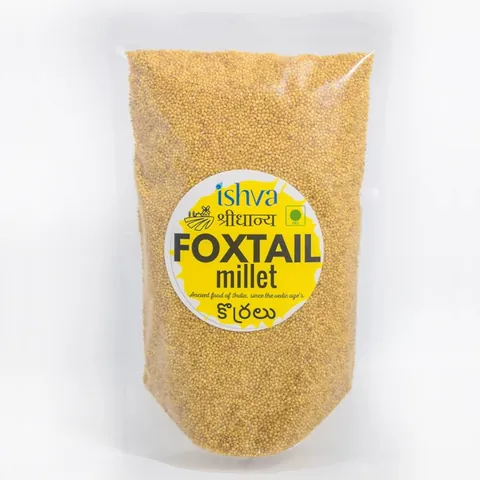
Foxtail Millet
Setaria italica · కొర్రలు Korralu · कंगनी Kangni · Thinai · Navane
VegetarianWhole foxtail millet: korralu in Telugu, kangni in Hindi, tinai in Tamil. Packed in Hyderabad in a 500 g pouch with the bright yellow Ishva label, the one you will find on the DMart shelf.
Few grains have a longer written history in India. The White Yajurveda names it, as priyangu, among the grains of the fire-altar litany, and the Taittiriya Samhita describes priyangu cooked in milk as an offering to the Maruts. Kautilya's Arthashastra lists it among the crops sown first in the season, and the Sangam poems of Tamil Nadu speak of fresh tinai, cooked and served with milk to a visiting bard.
Foxtail millet was first domesticated in northern China. Today it cooks like rice: in pongal, upma, lemon rice, kheer and adhirasam. The recipes here come from published sources, and the story tab shows the very pages of the old texts.
Hear it pour
Our own pack of foxtail millet, opened and poured into a steel bowl — filmed on a phone, nothing added.
Turn the sound on: the grain has its own sound as it falls.
On the pack
- Ingredients
- Foxtail Millet Grains
- Shelf life
- Best before nine months from packing
- Storage
- Transfer the contents to an airtight container after opening and store in a cool, dry place. Do not buy a pack that is open, tampered or punctured.
In the Vedic rituals
Foxtail Millet is named in 8 of the rituals of the Vedas:
- The fire-altar litany (vasor dhārā) — A litany for the fire altar lists the grains of the household one by one: rice, barley, beans, sesame, mung, khalva, then priyangu, anu and shyamaka, wild rice, wheat and lentils. Only grains are named; nothing is cooked. (VS XVIII.12; TS IV.7.4.2)
- The offering to the Maruts — The clearest millet dish in the Black Yajurveda: priyangu cooked in milk from a speckled cow, offered as a pot to the Maruts. The Maitrayani and Kathaka Samhitas give the same rite. (TS II.2.11.4)
- The offerings to the lunar mansions (nakṣatreṣṭi) — In the offerings to the lunar mansions, Rudra (for the mansion Ardra) receives a pot of priyangu cooked in milk. (TB III.1.4.4)
- The mantha rite (Bṛhadāraṇyaka Upaniṣad) — The ten cultivated grains, including anu and priyangu, are ground together and moistened with curd, honey and ghee for the mantha rite. It is a ten-grain mash, not a millet dish, and gives no quantities. (SB XIV.9.3.22 = BAU VI.3.13)
- The royal consecration (rājasūya / punarabhiṣeka) — For a royal consecration the priests gather young shoots of four plants: rice, large rice, priyangu and barley. Shoots, not a cooked dish. (AB VIII.16)
- Building the fire altar (agnicayana) — Seeds of fourteen plants are sown on the fire altar: seven cultivated (with priyangu and anu among them) and seven wild (with shyamaka, wild sesame and gavidhuka among them). (ApSS XVI.19.13)
- A household rite (Grihya Sutra) — A list of plants and grains gathered for a rite names shyamaka and priyangu with shami, durva and white mustard. (VarGS 14.5)
- Grains set out for the fire offerings — Lists the grains whose kernels may be set out for the fire offerings: barley, rice, large rice, priyangu, shyamaka and sesame. (AVPariś 23.7.2)
Our summary of each passage, with its reference; the links open the translation or the text.
In the old books
- The Shukla Yajurveda (Vājasaneyi Saṃhitā 18.12) names priyaṅgu among its grains; the Monier-Williams Sanskrit dictionary identifies priyaṅgu as Italian (foxtail) millet. (Vājasaneyi Saṃhitā 18, Monier-Williams)
- Kauṭilya's Arthaśāstra (2.24.12) lists priyaṅgu with kodrava among the crops sown first in the season. (Arthaśāstra, GRETIL text)
- The Sangam-era Tamil poem Kuṟiñcippāṭṭu by Kapilar (lines 35-39) speaks of tiṉai, which the Tamil Lexicon defines as Italian millet. (Kuṟiñcippāṭṭu, Project Madurai, Tamil Lexicon)
- Kausika Sutra, KauśS 8.20 — Defines the "mixed grains" used in its rites: rice, barley, wheat, upavaka, sesame, priyangu and shyamaka. (source)
- Vaikhanasa Dharmasutra, VaikhDS I.7 — A class of hermit feeds his guests on whatever priyangu, barley, shyamaka and wild rice he has gathered. (source)
How it was cooked
Names in Hindi, Tamil and Kannada: ICAR-Indian Institute of Millets Research; Telugu name as on our pack.
Vegetarian recipes with foxtail millet, each shared as its source gives it, with the source named.
- Foxtail Millet Sweet PongalFestival · South India · sweet
- Foxtail Millet Adhirasam (Thinai Adhirasam)Festival · Tamil Nadu · sweet
- Foxtail Millet Ven Pongal (Savoury Pongal)Traditional · Tamil Nadu · breakfast
- Foxtail Millet Lemon RiceTraditional · South India · lunch
- Foxtail Millet Raw Mango RiceTraditional · South India · lunch
- Foxtail Millet Bisi Bele BathTraditional · Karnataka · lunch
- Foxtail Millet Kajjikayalu (Stuffed Sweet Pastries)Festival · Andhra Pradesh / Telangana · sweet
- Foxtail Millet Salad with Raw Mango and CucumberModern · Pan-India · snack
- Thinai Puttu (Sweet Steamed Foxtail Millet)Traditional · Tamil Nadu · breakfast
- Foxtail Millet, Kidney Bean and Sprout SaladModern · Pan-India (modern) · lunch
- Foxtail Millet Kachori (with Spiced Onion and Potato Filling)Traditional · North India · snack
- Sticky Millet Cake (Foxtail Millet Boiled in Banana Leaf)Traditional · East India (FSSAI East Region menu) · snack
- Foxtail Millet KheerTraditional · Pan-India · sweet
- Thinai Poli (Foxtail Millet Sweet Stuffed Flatbread)Festival · Tamil Nadu · sweet
- Pasunthinai Mūral (Boiled Fresh Foxtail Millet, from the Perumpāṇāṟṟuppaṭai)Ancient · Tamil Nadu (Sangam poetry) · lunch
Nutrition
India's food composition tables (IFCT 2017) have no entry for foxtail millet, and other published figures differ widely — so we will publish the values from a laboratory test of our own pack.
Questions people ask about foxtail millet
What is foxtail millet called in Telugu, Hindi, Tamil and Kannada?
Foxtail millet (Setaria italica) is korralu (కొర్రలు) in Telugu, kangni (कंगनी) in Hindi, thinai (தினை) in Tamil, navane (ನವಣೆ) in Kannada and rala (राळा) in Marathi. (ICAR-IIMR)
What is korralu in English?
Korralu is foxtail millet, Setaria italica. Ishva packs it in Hyderabad as Ishva Foxtail Millet, in a 500 g pouch. (ICAR-IIMR)
What is the nutrition of foxtail millet per 100 g?
Per 100 g of the raw grain, the values printed on our pack: 331 kcal, 12.3 g protein and 60.9 g carbohydrate (ICMR-NIN 2018, as published on the APEDA millet portal). India's 2017 food composition tables have no entry for foxtail millet. (APEDA Millet Portal, foxtail millet (values from ICMR-NIN 2018))
How do I cook foxtail millet?
Soak it overnight, then cook it as you cook rice: ICAR-IIMR's millet-rice recipes use 2 cups of water for 1 cup of millet. (ICAR-IIMR, Millets Recipes: A Healthy Choice)
Is foxtail millet gluten-free?
Yes. Foxtail millet is naturally gluten-free.
How is foxtail millet different from rice?
Per 100 g raw, foxtail millet has 12.3 g protein against 7.9 g in white rice, and 60.9 g carbohydrate against 78.2 g (the table below). It cooks like rice and goes into lemon rice, pongal, upma and kheer.
What does Ishva Foxtail Millet cost?
MRP on the pack: 500 g ₹90. On the DMart shelf in November 2026: 500 g ₹70; store offers change from day to day.
Where can I buy Ishva Foxtail Millet near me?
At DMart stores in Telangana and Andhra Pradesh: 84 DMart stores list Ishva Foxtail Millet. Enter your PIN code on this page to find the nearest one.
How long does a pack keep?
Best before nine months from packing. After opening, move the grain to an airtight container and keep it in a cool, dry place.
Compared with rice and wheat, per 100 g
| Grain | Energy kcal | Protein g | Fibre g | Carbs g | Fat g |
|---|---|---|---|---|---|
| Rice, white (milled) IFCT 2017 A015 | 356 | 7.9 | 2.8 | 78.2 | 0.5 |
| Wheat flour (atta) IFCT 2017 A019 | 320 | 10.6 | 11.4 | 64.2 | 1.5 |
| Kodo millet IFCT 2017 A017 | 332 | 8.9 | 6.4 | 66.2 | 2.6 |
| Little millet IFCT 2017 A016 | 346 | 10.1 | 7.7 | 65.6 | 3.9 |
| Quinoa IFCT 2017 A009, one regional sample | 328 | 13.1 | 14.7 | 53.7 | 5.5 |
| Foxtail millet ICMR-NIN 2018 via APEDA; not in IFCT 2017 | 331 | 12.3 | — | 60.9 | — |
Per 100 g of the raw grain. Energy converted from the tables' kJ (1 kcal = 4.184 kJ). Published values for each grain, not a laboratory test of a pack. Sources: Indian Food Composition Tables 2017, ICMR-National Institute of Nutrition; foxtail millet: APEDA Millet Portal, foxtail millet (values from ICMR-NIN 2018).