
Barnyard millet
Echinochloa frumentaceaNames: ICAR-Indian Institute of Millets Research
Pictures
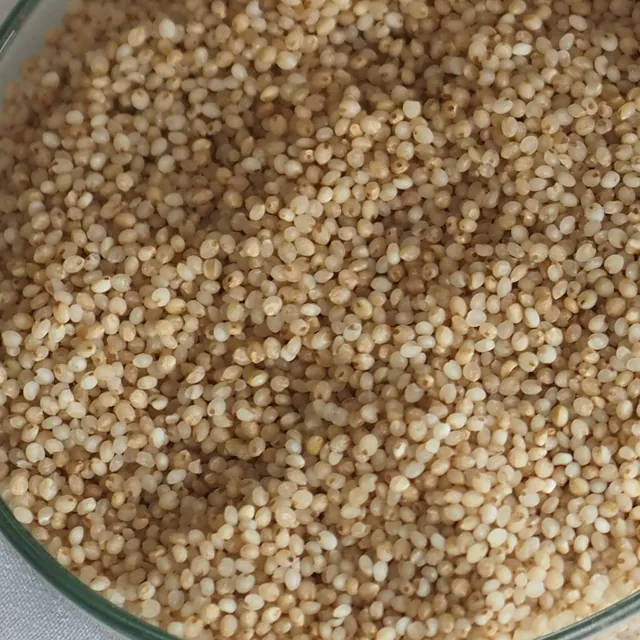
Hear it pour
Our own pack of barnyard millet, opened and poured into a steel bowl — filmed on a phone, nothing added.
Turn the sound on: the grain has its own sound as it falls.
Every nutrient in the raw grain — 12 values, per 100 g
Energy, protein, fat, carbohydrate, fibre4
| Carbohydrate | 65.5 g |
| Protein | 6.2 g |
| Fat | 2.2 g |
| Energy | 307 kcal |
Not detected in this grain (the table leaves it blank or zero): Dietary fibre (total).
Minerals3
| Calcium | 20 mg |
| Phosphorus | 280 mg |
| Magnesium | 82 mg |
Vitamins3
| Thiamine (B1) | 0.33 mg |
| Riboflavin (B2) | 0.1 mg |
| Niacin (B3) | 4.2 mg |
Not detected in this grain (the table leaves it blank or zero): Folate (B9).
Source, one for the whole list: NIN Nutritive Value of Indian Foods (2007), as printed in ICAR-IIMR 'The Story of Millets' (2018). Values exactly as the table prints them; published values for the grain, not a laboratory test of our packs. Tap a name for what it is and does.
In the Vedas and Sanskrit texts
- Vajasaneyi Samhita, VS XVIII.12 — A litany for the fire altar lists the grains of the household one by one: rice, barley, beans, sesame, mung, khalva, then priyangu, anu and shyamaka, wild rice, wheat and lentils. Only grains are named; nothing is cooked. (Ralph T. H. Griffith's translation)
- Taittiriya Samhita, TS IV.7.4.2 — The Black Yajurveda version of the same litany. The household grains are listed and the list closes with three millets (Keith gives their botanical names) and wild rice. A list, not a dish. (Arthur Berriedale Keith's translation)
- Taittiriya Samhita, TS I.8.1.2 — Among the preliminary offerings of the royal consecration, a pot of shyamaka grain is offered to Soma; the priest receives a garment for it. (Arthur Berriedale Keith's translation)
- Taittiriya Samhita, TS I.8.10.1 — In a row of eight offerings, each tied to one grain, Soma as lord of the forest receives a pot of shyamaka. Black rice, quick rice, wild rice, large rice, amba grain, barley and gavidhuka grass seed go to the other seven. (Arthur Berriedale Keith's translation)
- Taittiriya Brahmana, TB III.1.4.3 — In the same series, Soma (for the mansion Mrigashirsha) receives a pot of shyamaka cooked in milk. (the Sanskrit text)
- Maitrayani Samhita, MS II.2.6 — A four-part offering for agreement among equals: Agni with the Vasus, Soma with the Rudras (a pot of shyamaka), Indra with the Maruts and Varuna with the Adityas. (the Sanskrit text)
- Atharvaveda, AV XIX.50.4 — A night prayer compares a hostile man to a millet seed that flies off in the wind and is never found again. (William Dwight Whitney (rev. C. R. Lanman)'s translation)
- Kausitaki Brahmana, KB IV.12 in Keith — The first-fruits offering is held in the rains when the shyamaka harvest is in, after the order is given to gather the grain. (Arthur Berriedale Keith's translation)
- Shatapatha Brahmana, Eggeling's notes on the first-fruits offering, SB II.4.3 intro — Eggeling explains, from the Katyayana sutra, that first-fruits are offered at the shyamaka harvest in the rains or autumn, as a pot of new shyamaka for Soma. (Julius Eggeling's translation)
- Asvalayana Srauta Sutra, AsvSS II.9.1, II.9.7, II.9.12 — The first-fruits offering is made with rice, shyamaka and barley; at the shyamaka offering there is a pot for Soma. (the Sanskrit text)
- Sankhayana Srauta Sutra, SSS III.12.1 — Names a separate first-fruits offering of shyamaka for Soma, next to one of bamboo seed. (the Sanskrit text)
- Apastamba Srauta Sutra, ApSS VI.29.3, 29.10, 30.7, 30.10, 31.1, 31.14 — The first-fruits are offered of rice, barley and shyamaka; the new-grain set includes a pot cooked in milk for the All-gods and a pot of shyamaka for Soma; shyamaka is offered in the rains. (the Sanskrit text)
- Apastamba Srauta Sutra, ApSS IX.14.14 — Among the gifts a priest may receive for one rite is a vessel of shyamaka grain. (the Sanskrit text)
- Apastamba Srauta Sutra, ApSS XVI.19.13 — Seeds of fourteen plants are sown on the fire altar: seven cultivated (with priyangu and anu among them) and seven wild (with shyamaka, wild sesame and gavidhuka among them). (the Sanskrit text)
- Gobhila Grihya Sutra, GGS III.8.9, 22-23 — At the household first-fruits rite a mess of new rice is boiled with milk; shyamaka and barley first-fruits are done the same way, each eaten with its own verse. (Hermann Oldenberg's translation)
- Jaiminiya Grihya Sutra, JGS I.24 — First-fruits are offered in autumn of rice, in spring of barley and in the rains of millet; each time a mess of whole boiled grain goes to the gods and the household then eats the new grain. (W. Caland's translation)
- Manava Grihya Sutra, MGS II.3.11-12 — The first-fruits are cooked in milk as a pot dish; in autumn the offering to Soma is of shyamaka, in spring of bamboo seed. (the Sanskrit text)
- Apastamba Grihya Sutra with Sudarsana's commentary, ApGS VII.19.6-7; commentary — The household first-fruits rite cooks a pot of the fresh grain. The sutra names no grain; the later commentary says the same rite covers shyamaka and bamboo seed. (Hermann Oldenberg's translation)
- Varaha Grihya Sutra, VarGS 14.5 — A list of plants and grains gathered for a rite names shyamaka and priyangu with shami, durva and white mustard. (the Sanskrit text)
- Kausika Sutra, KauśS 8.20 — Defines the "mixed grains" used in its rites: rice, barley, wheat, upavaka, sesame, priyangu and shyamaka. (the Sanskrit text)
- Kausika Sutra, KauśS 74.16 — In autumn the shyamaka first-fruits go to Soma. (the Sanskrit text)
- Atharvaveda Parisishta, AVPariś 23.7.2 — Lists the grains whose kernels may be set out for the fire offerings: barley, rice, large rice, priyangu, shyamaka and sesame. (the Sanskrit text)
- Chandogya Upanishad, ChU III.14.3 — The self within the heart is called smaller than a grain of rice, barley, mustard, shyamaka, or even a shyamaka kernel. (F. Max Muller's translation)
- Shatapatha Brahmana, SB X.6.3.2 — The same comparison in the Shatapatha: like a grain of rice, barley, millet or the smallest millet kernel. (Julius Eggeling's translation)
- Baudhayana Dharmasutra, BDS III.2.18 — One way of life for a forest hermit is to live on what the forest gives: fruits of trees and creepers and grass seeds such as wild shyamaka and wild sesame. (Georg Buhler's translation)
- Vaikhanasa Dharmasutra, VaikhDS I.7 — A class of hermit feeds his guests on whatever priyangu, barley, shyamaka and wild rice he has gathered. (the Sanskrit text)
- Kṣemakutūhala, 12th utsava, verse 3 — New husked śyāmāka grains, an eighth part, cooked in milk boiled without water, finished with ghee and sugar. (the Sanskrit text)
- Haribhaktivilāsa, 5.44 — Śyāmāka grain is put with lotus and dūrvā grass into the water for washing the deity's feet; ritual, not food. (the Sanskrit text)
Each line is our summary of the passage, with its reference. Health and medicinal statements in these texts are left out.
Where it comes from
- Indian barnyard millet (Echinochloa colona) was domesticated in India; Japanese barnyard millet in Japan, some 4,000 years ago. (de Wet et al. 1983, Economic Botany)
In India’s old books
- The Shukla Yajurveda (Vājasaneyi Saṃhitā 18.12) names śyāmāka among its grains; the Monier-Williams dictionary defines śyāmāka as a cultivated millet (Panicum frumentaceum). (Vājasaneyi Saṃhitā 18) (Monier-Williams)
Recipes
- Barnyard Millet Navratri BruschettaFestival · Snack
- Barnyard Millet Kozhukattai (Kuthiraivali Kolukattai)Traditional · Snack
- Barnyard Millet PayasamFestival · Sweet
- Bhagar Upma (Barnyard Millet Upma with Peanuts)Traditional · Breakfast
- Gur Wali Maheri (Barnyard Millet Cooked in Sweetened Curd)Traditional · Breakfast
- Kuthiraivali Idiyappam (Barnyard Millet String Hoppers)Traditional · Breakfast
- Kuthiraivali Pongal (Barnyard Millet with Whole Green Gram)Traditional · Breakfast
- Barnyard Millet Puttu (Steamed with Coconut)Traditional · Lunch
- Kuthiraivali Biryani (Barnyard Millet Vegetable Biryani with Soya Chunks)Traditional · Lunch
- Stewed Pumpkin Samak Rice (Barnyard Millet with Pumpkin, Mushroom and Coconut Milk)Modern · Dinner
- Samak Chawal Idli (Barnyard Millet and Ragi Idli)Modern · Snack
- Barnyard Millet Modak (with Coconut, Peanut and Sesame Filling)Festival · Sweet
- Barnyard Millet Milk Cake (Kalakand)Festival · Sweet
- Barnyard Millet Mango MilkshakeModern · Drink
- Shyamaka Charu (Boiled Barnyard Millet, the Vedic Pot of Grain)Ancient · Lunch