
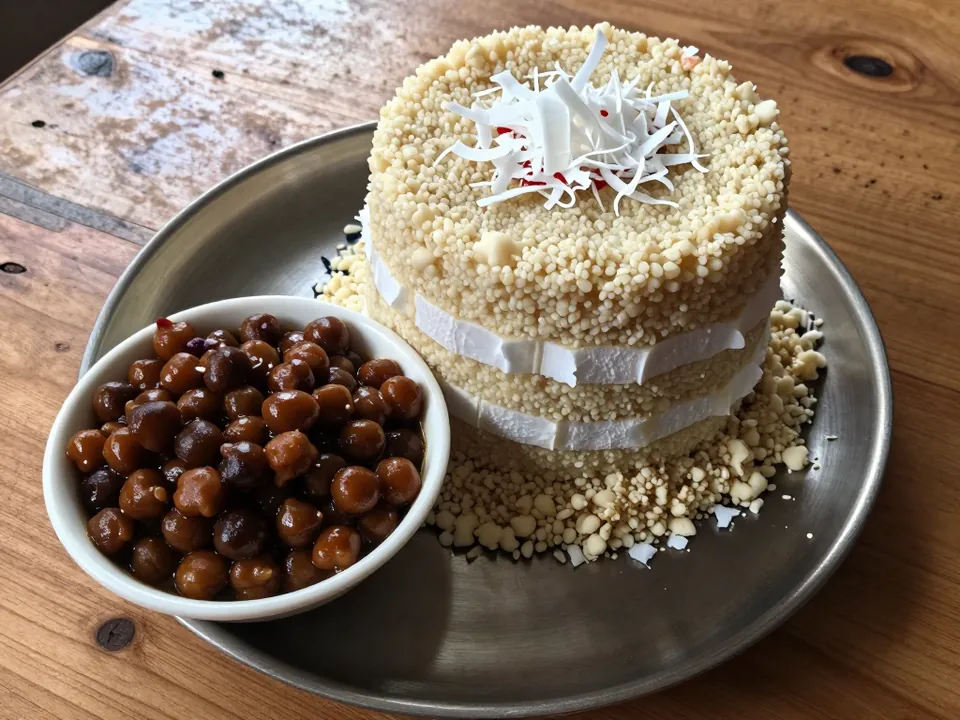
Barnyard Millet Puttu (Steamed with Coconut)
Prep 10 min · Cook 20 min · Serves 11
Make
Ingredients
- barnyard millet flour — 1 kg (listed as 'barnyard millet' for all 11 servings; the method works with 1 cup of flour at a time)
- fresh coconut — 200 g (grated, for all 11 servings; 2 to 3 tbsp go into each filling of the puttu maker)
- salt (as desired)
- water — 1/2 cup (per cup of flour, sprinkled in; plus 2 to 3 cups in the base of the puttu maker)
Method
- Work one cup of flour at a time. Put 1 cup of barnyard millet flour and salt in a bowl and sprinkle 1/2 cup of water over it.
- Work it in with your fingertips. It is ready when a little pressed between your palms forms a lump.
- Pulse the dampened flour in a grinder to break up the lumps.
- Pour 2 to 3 cups of water into the base of the puttu maker (puttu kudam) and set it on the stove to heat.
- Fit the perforated disc inside the tube, spread 2 to 3 tablespoons of fresh coconut over it, then spoon in the flour until the tube is half full. Put on the lid and set the tube on the base once the water is boiling.
- Steam on medium heat until steam comes out of the vent at the top, then turn off the heat.
- Lift the tube off, wait 3 to 4 minutes, and push the puttu out with a wooden stick. Serve hot or warm with kadala curry or vegetable stew. Repeat, a cup of flour at a time, until the flour and coconut are used up.
Water and timing
Water: 1/2 cup sprinkled over each cup of barnyard millet flour, until a pinch pressed in the palm holds as a lump, plus 2 to 3 cups boiling in the base of the puttu maker — as the FSSAI book gives.
From: FSSAI, Shree Anna (Millets) Recipes, PDF p. 69 (printed p. 55)
Fresh atta: grind small, use soon
- Millets keep for months as whole grain; flour is best ground as it is needed, because it turns rancid. (FAO, Sorghum and millets in human nutrition (1995))
- Bajra changes fastest: its grain stores for months, but its milled flour has a very short shelf life. (ICAR-IIMR scientists, Food Chemistry Advances (2023) (DOI 10.1016/j.focha.2023.100190))
- In an Indian study, untreated bajra flour stayed within the quality limit only about 2 days at room temperature. (ICAR-IARI, Indian Journal of Agricultural Sciences (2016))
- Ragi flour keeps better than foxtail, barnyard or bajra flour (it carries less fat). (Planta (2024), review)
- Keep atta closed and cool: bajra flour kept best in polythene and worst in gunny sacks; grains should be dry and in airtight containers. (Chaudhary & Kapoor, J Sci Food Agric (1984); ICMR-NIN Dietary Guidelines (2024) (DOI 10.1002/jsfa.2740351113))
- Going off shows first as smell and taste — sour, musty or dusty, then bitter. (Lai & Varriano-Marston, Cereal Chemistry (1980))
So: buy the grain, grind a week’s worth at a time — less for bajra in summer.
Adapted from FSSAI, Shree Anna (Millets) Recipes, PDF p. 69 (printed p. 55), written in our own words.