
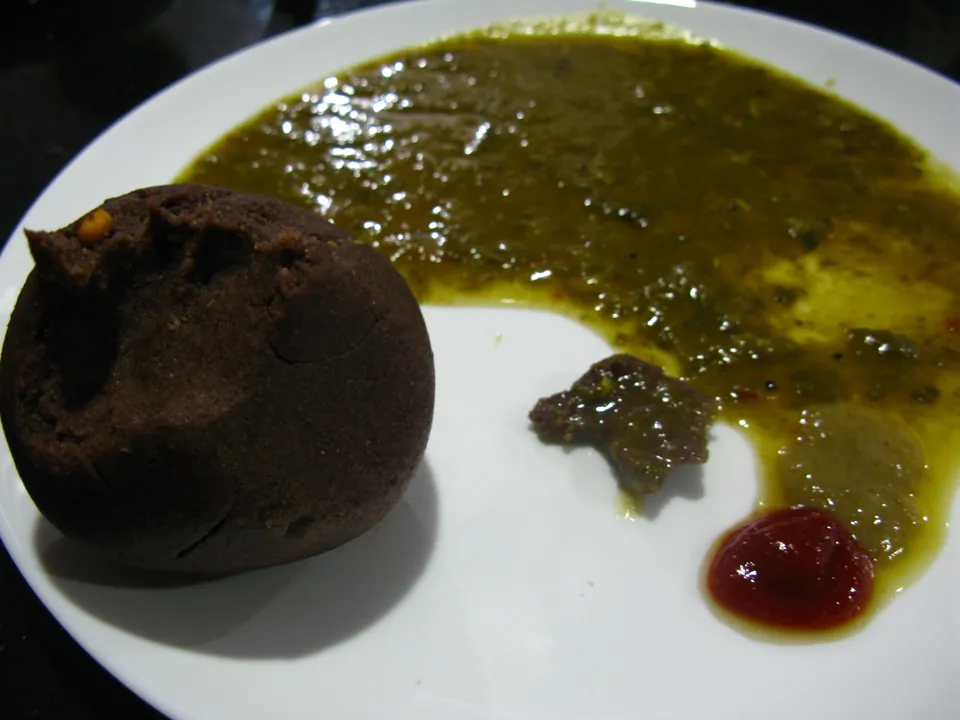
Ragi Mudde (Finger Millet Balls)
Prep 5 min · Cook 10 min · Serves 4
Make
Ingredients
- ragi (finger millet) flour — 1 cup
- water — 2 1/4 cups (2 cups to boil; the other 1/4 cup is whisked with 2 tbsp of the flour)
- salt (to taste)
- ghee — 1 + 2 tbsp (2 tbsp go into the mudde; the rest greases the shaping bowl)
Method
- Bring 2 cups of the water to a boil in a heavy saucepan and add the salt.
- In a small bowl, whisk 2 tbsp of the ragi flour into the remaining 1/4 cup of water until there are no lumps.
- Pour this slurry into the boiling water and keep stirring; it will start to thicken.
- Scatter the rest of the flour in an even layer over the top and let it bubble for about a minute without stirring.
- Now work the mixture with a sturdy spatula or wooden stick, stirring in one direction and pressing out any lumps. Keep the heat low and carry on until the whole mass is thick.
- Add 2 tbsp ghee and keep stirring until the dough looks glossy.
- Cover and let it steam on low heat for about 5 minutes, then switch off and leave it covered for 5 minutes more.
- Grease a small bowl with ghee, drop in about 2 heaped tablespoons of the hot mudde and swirl the bowl until it rolls into a smooth ball. Shape all the balls while the mudde is still hot, and serve with a hot curry.
Water and timing
Water: 2 1/4 cups for 1 cup of ragi flour — 2 cups brought to the boil and 1/4 cup for the flour slurry, as the FSSAI ingredient list totals.
From: FSSAI, Shree Anna (Millets) Recipes, PDF p. 77 (printed p. 63)
Fresh atta: grind small, use soon
- Millets keep for months as whole grain; flour is best ground as it is needed, because it turns rancid. (FAO, Sorghum and millets in human nutrition (1995))
- Bajra changes fastest: its grain stores for months, but its milled flour has a very short shelf life. (ICAR-IIMR scientists, Food Chemistry Advances (2023) (DOI 10.1016/j.focha.2023.100190))
- In an Indian study, untreated bajra flour stayed within the quality limit only about 2 days at room temperature. (ICAR-IARI, Indian Journal of Agricultural Sciences (2016))
- Ragi flour keeps better than foxtail, barnyard or bajra flour (it carries less fat). (Planta (2024), review)
- Keep atta closed and cool: bajra flour kept best in polythene and worst in gunny sacks; grains should be dry and in airtight containers. (Chaudhary & Kapoor, J Sci Food Agric (1984); ICMR-NIN Dietary Guidelines (2024) (DOI 10.1002/jsfa.2740351113))
- Going off shows first as smell and taste — sour, musty or dusty, then bitter. (Lai & Varriano-Marston, Cereal Chemistry (1980))
So: buy the grain, grind a week’s worth at a time — less for bajra in summer.
Adapted from FSSAI, Shree Anna (Millets) Recipes, PDF p. 77 (printed p. 63), written in our own words.