
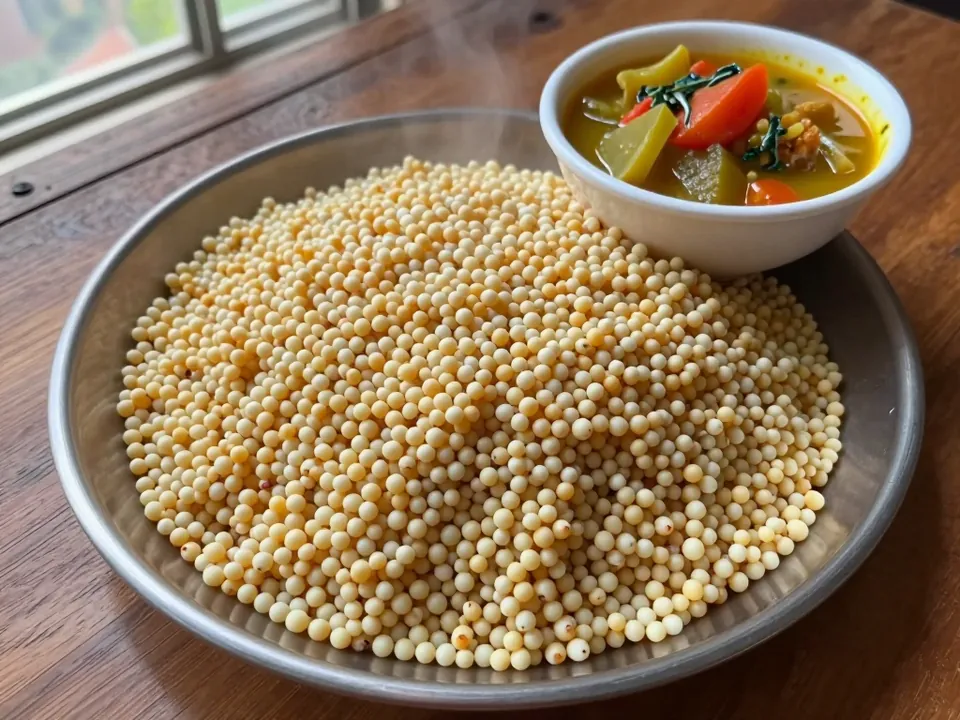
Jonna Kudu (Plain Boiled Whole Jowar)
Cook 40 min · Servings not given in the source
Ingredients
- whole jowar (sorghum grain) — 1 cup (FAO gives volumes: 1 volume of grain. Dehulled (pearled) jowar can be used and needs no soaking)
- water, for boiling — 3 to 4 cups (3 to 4 volumes of water to 1 volume of grain (FAO))
- water, for soaking (enough to cover the grain well, as needed)
Method
- Pick through the jowar for stones and loose husk, rinse it, then leave it under plenty of water overnight.
- Next morning tip it into a sieve and wash it under running water until the water stays clear.
- Boil 3 to 4 cups of fresh water in a heavy pan for every cup of grain and add the soaked jowar.
- Cover and let it bubble gently until each grain is tender when bitten; this takes from 20 to 40 minutes depending on the grain.
- Serve it hot, the way you would serve plain cooked rice, with a vegetable curry.
From the old texts
“Even the most handsome person Kama, the god of love, will be served with Sorghum meal.”
డెసగంగా రంభయైన నేకులె వడుకున్
వసుధేశుడైన దున్నును
కుసుమాస్త్రుండైన జొన్నకూడే కుడుచున్.
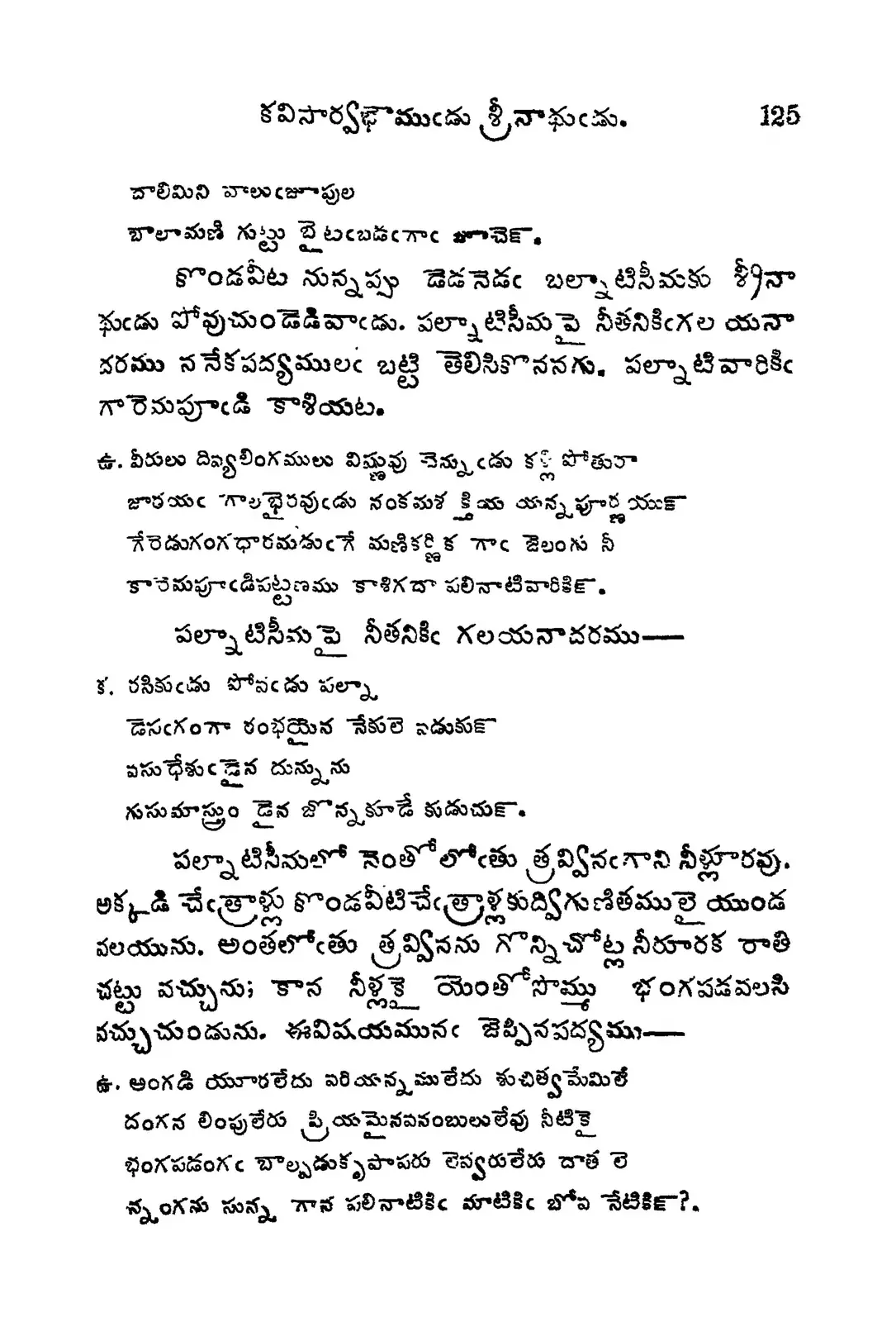 The printed page
Cāṭupadyamaṇimañjari (part 1), Vēṭūri Prabhākaraśāstrigārice sampāditamu; reprint that still carries the 'modaṭikūrpu' (first-edition) prefa (ed. Veturi Prabhakara Sastri), Madras (Cennapuri): Vavilla Ramaswami Sastrulu & Sons, 1924, p. 125
Attributed to Srinatha in the chatu tradition (Chatupadya Manimanjari places it among his Palnadu verses); Ranjan Babu cites it from 'Vallabhacharya: Kridabhiramam, p. 93', Chatu (stray) verse on Palnadu, 'rasikudu povadu Palnadu ...' - verse 323 in Chatupadya Manimanjari (late 14th to early 15th century (Srinatha's period, per Narayana Rao and Shulman); the attribution is traditional), Chatupadya Manimanjari, verse 323; English: Ranjan Babu (2000), PDF p. 16 (printed p. 8), and the line translation in note 20, PDF p. 144 (printed p. 136), translated by P. Ranjan Babu — read the translation.
Which grain: “The great millet, cholam, jowari.” (C. P. Brown, A Telugu-English Dictionary (2nd ed., 1903), Digital Dictionaries of South Asia (DSAL), p. 484, entry జొన్న)
Amounts and times: the old text gives none, so they are from Sorghum and millets in human nutrition (FAO Food and Nutrition Series No. 27), FAO, Rome, 1995 - Annex: Some recipes based on sorghum and millets, Annex.
Tips
- From the source: FAO says the soaked grain may be steamed instead of boiled, until soft.
- General practice: if some water is still in the pan once the grain is tender, pour it off.
- Grains differ in hardness: cook within FAO's 20 to 40 minutes, until soft.
Adapted from Srinatha (attributed), a chatu verse on Palnadu, PDF p. 16 (printed p. 8); note 20, written in our own words.