
Bajra (pearl millet)
Pennisetum glaucumNames: ICAR-Indian Institute of Millets Research
Pictures
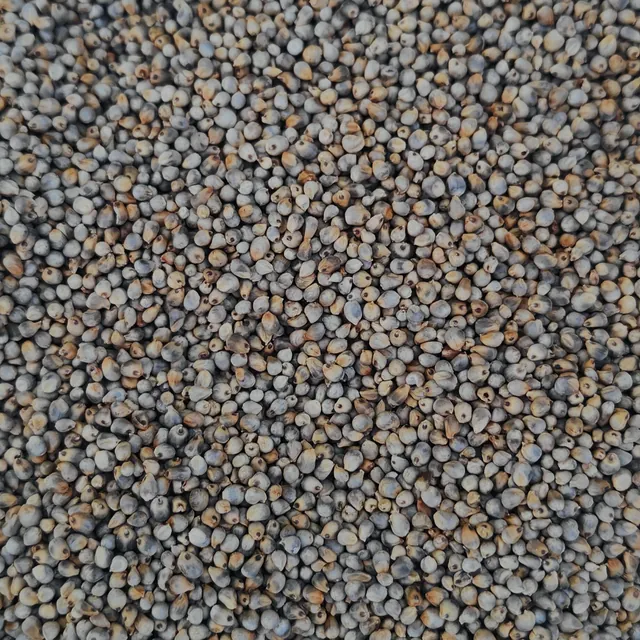
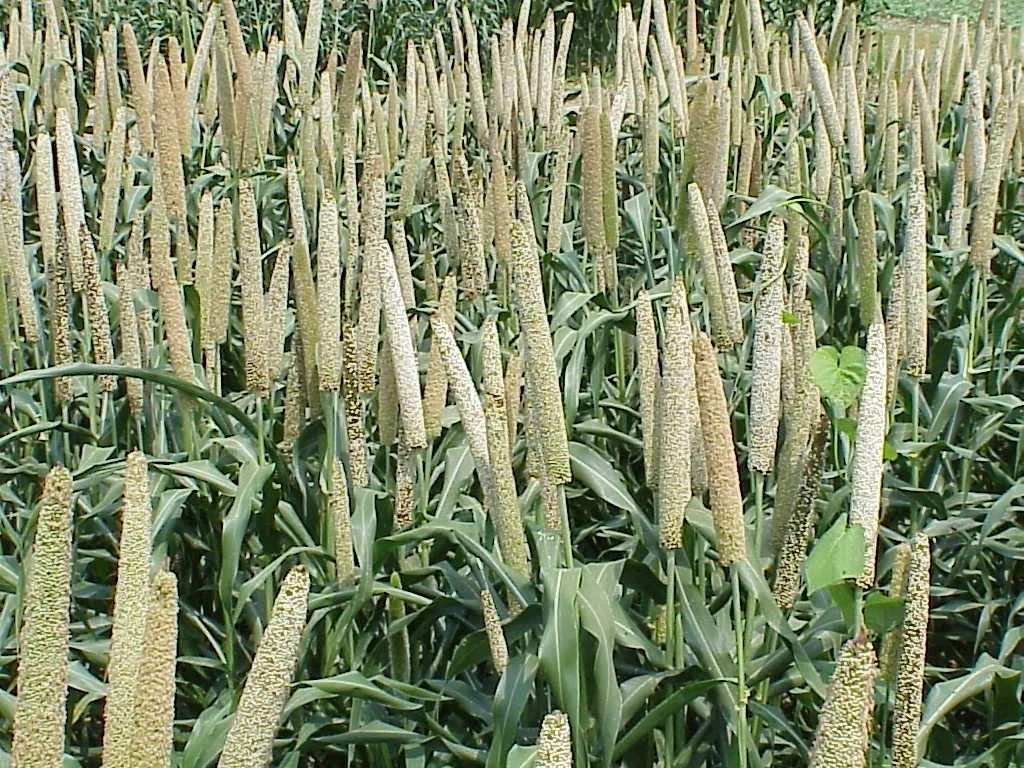
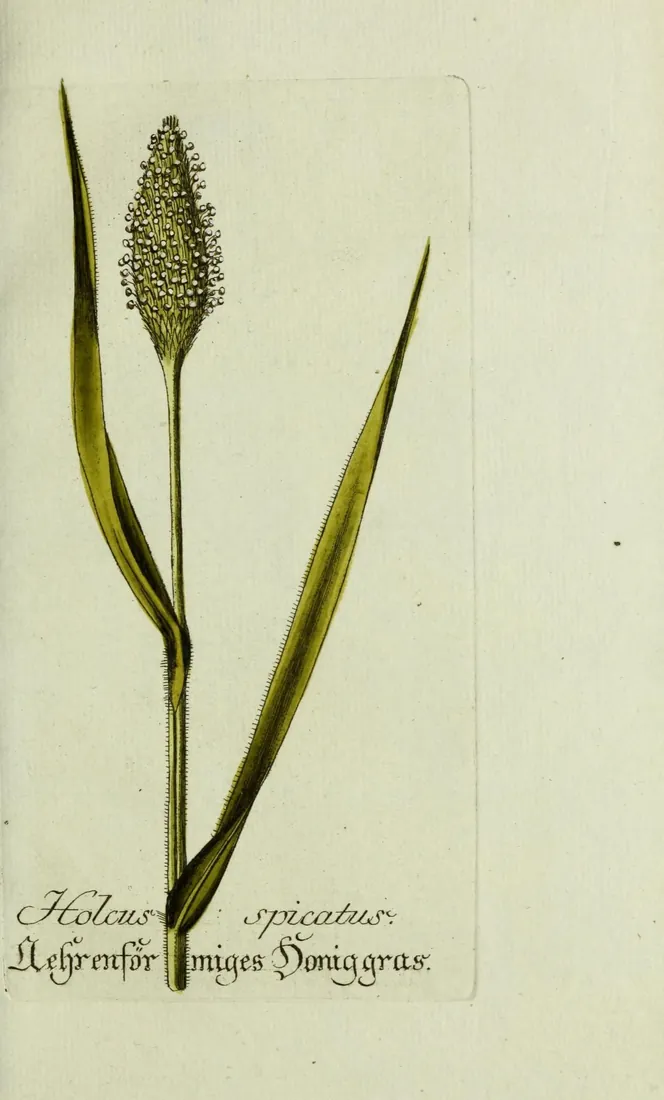
Nutrition of the raw grain, per 100 g
| Energy | 348 kcal |
| Protein | 10.96 g |
| Fat | 5.43 g |
| Carbohydrate (available) | 61.78 g |
| Dietary fibre (total) | 11.49 g |
| Calcium | 27.35 mg |
| Iron | 6.42 mg |
| Magnesium | 124 mg |
| Phosphorus | 289 mg |
| Zinc | 2.76 mg |
Source: Indian Food Composition Tables 2017, ICMR-National Institute of Nutrition, food code A003. Energy converted from kilojoules (1 kcal = 4.184 kJ).
Every nutrient in the raw grain — 94 values, per 100 g
Energy, protein, fat, carbohydrate, fibre9
| Water (moisture) | 8.97 g |
| Protein | 10.96 g |
| Ash (total minerals) | 1.37 g |
| Fat | 5.43 g |
| Dietary fibre (total) | 11.49 g |
| Insoluble fibre | 9.14 g |
| Soluble fibre | 2.34 g |
| Carbohydrate (available) | 61.78 g |
| Energy | 1456 kJ |
Starch and sugars5
| Available carbohydrate (starch + sugars) | 56.02 g |
| Starch | 55.21 g |
| Fructose | 0.21 g |
| Glucose | 0.6 g |
| Free sugars (total) | 0.81 g |
Not detected in this grain (the table leaves it blank or zero): Maltose, Sucrose.
Minerals5
| Calcium | 27.35 mg |
| Magnesium | 124 mg |
| Phosphorus | 289 mg |
| Potassium | 365 mg |
| Sodium | 4.11 mg |
Trace elements8
Vitamins12
| Thiamine (B1) | 0.25 mg |
| Riboflavin (B2) | 0.2 mg |
| Niacin (B3) | 0.86 mg |
| Pantothenic acid (B5) | 0.5 mg |
| Vitamin B6 | 0.27 mg |
| Biotin (B7) | 0.64 µg |
| Folate (B9) | 36.11 µg |
| Vitamin D2 (ergocalciferol) | 5.65 µg |
| Vitamin E: alpha-tocopherol | 0.1 mg |
| Vitamin E: gamma-tocopherol | 1.42 mg |
| Vitamin E (alpha-tocopherol equivalents) | 0.24 mg |
| Vitamin K1 | 2.85 µg |
Not detected in this grain (the table leaves it blank or zero): Vitamin E: alpha-tocotrienol, Vitamin E: beta-tocopherol, Vitamin E: delta-tocopherol, Vitamin E: gamma-tocotrienol.
Carotenoids4
| Lutein | 29.69 µg |
| Zeaxanthin | 9.3 µg |
| Beta-carotene | 28.23 µg |
| Carotenoids (total) | 293 µg |
Amino acids18 · g per 100 g of protein
| Histidine | 2.15 g |
| Isoleucine | 3.45 g |
| Leucine | 8.52 g |
| Lysine | 3.19 g |
| Methionine | 2.11 g |
| Cystine | 1.23 g |
| Phenylalanine | 4.82 g |
| Threonine | 3.55 g |
| Tryptophan | 1.33 g |
| Valine | 4.79 g |
| Alanine | 7.68 g |
| Arginine | 4.54 g |
| Aspartic acid | 7.77 g |
| Glutamic acid | 17.42 g |
| Glycine | 3.52 g |
| Proline | 5.3 g |
| Serine | 4.44 g |
| Tyrosine | 2.67 g |
Fatty acids10
| Palmitic acid (C16:0) | 729 mg |
| Stearic acid (C18:0) | 128 mg |
| Arachidic acid (C20:0) | 18.21 mg |
| Palmitoleic acid (C16:1) | 6.97 mg |
| Oleic acid (C18:1) | 1040 mg |
| Linoleic acid (C18:2, omega-6) | 1844 mg |
| Alpha-linolenic acid (C18:3, omega-3) | 140 mg |
| Saturated fat (total) | 875 mg |
| Monounsaturated fat (total) | 1047 mg |
| Polyunsaturated fat (total) | 1984 mg |
Not detected in this grain (the table leaves it blank or zero): Behenic acid (C22:0), Capric acid (C10:0), Eicosenoic acid (C20:1), Erucic acid (C22:1), Lauric acid (C12:0), Lignoceric acid (C24:0), Myristic acid (C14:0), Myristoleic acid (C14:1).
Organic acids7
| Oxalate (total) | 53.13 mg |
| Oxalate (soluble) | 43.49 mg |
| Oxalate (insoluble) | 9.88 mg |
| cis-Aconitic acid | 0.08 mg |
| Fumaric acid | 1.99 mg |
| Malic acid | 0.86 mg |
| Succinic acid | 0.02 mg |
Not detected in this grain (the table leaves it blank or zero): Citric acid, Quinic acid, Tartaric acid.
Polyphenols10
| 3,4-Dihydroxybenzoic acid | 0.03 mg |
| 3-Hydroxybenzaldehyde | 0.11 mg |
| p-Coumaric acid | 0.07 mg |
| Caffeic acid | 0.25 mg |
| Chlorogenic acid | 0.08 mg |
| Ferulic acid | 1.39 mg |
| Luteolin | 1.11 mg |
| Kaempferol | 0.14 mg |
| Isorhamnetin | 0.3 mg |
| Polyphenols (total) | 67.71 mg |
Not detected in this grain (the table leaves it blank or zero): Apigenin, Apigenin-7-O-neohesperidoside, Catechin, Cinnamic acid, Gallic acid, Protocatechuic acid, Quercetin, Quercetin-3-galactoside, Quercetin-3-glucoside, Quercetin-3-rutinoside (rutin), Sinapic acid, Vanillic acid, o-Coumaric acid.
Phytosterols3
| Campesterol | 15.84 mg |
| Stigmasterol | 4.97 mg |
| Beta-sitosterol | 75.87 mg |
Other compounds3
Not detected in this grain (the table leaves it blank or zero): Saponins (total).
Source, one for the whole list: Indian Food Composition Tables 2017, ICMR-NIN. Values exactly as the table prints them; published values for the grain, not a laboratory test of our packs. Tap a name for what it is and does.
Where it comes from
- Pearl millet originated in West Africa and is grown across the semi-arid tropics of Africa and Asia. (FAO, International Year of Millets 2023 - About)
- Domesticated pearl millet derives from wild populations of the far-western African savanna and/or Lake Chad region; a Hallur (Karnataka) find adds to evidence for pearl millet in India by the first half of the 2nd millennium BC. (Fuller D, Korisettar R, Venkatasubbaiah PC, Jones MK)
- No West African pearl millet find is older than 1700 BC, by which time domesticated pearl millet had reached India. (Weber SA & Fuller DQ, 'Millets and their role in early agriculture')
- Pearl millet is the sixth most important cereal globally. (ICAR-IIMR 'Millets Chalisa' farmer leaflet)
In India’s old books
- Tamil Lexicon, p.728: 'kampu, n. 1. Bulrush Millet ... (Patartta. 829). 2. Italian Millet. See centinai (Pin.)' (Tamil Lexicon (University of Madras, 1924-36), Digital Dictionaries of South Asi)
Where it grows
- Mostly a kharif crop; also a summer crop in parts of Gujarat, Rajasthan and UP, and a small rabi crop in Maharashtra and Gujarat. (ICAR-IIMR 'Millets Chalisa' farmer leaflet)
- Why dry land: adapted to drought, low soil fertility and high temperature; optimum rainfall 35-50 cm; sensitive to waterlogging and acid soils. (ICAR-IIMR 'Millets Chalisa' farmer leaflet)
In the kitchen
- ICAR-IIMR recipe: pearl millet roti - knead flour with hot water, pat out, bake on a tawa. (Dayakar Rao B, Vishala AD, Arlene Christina GD, Tonapi VA)
Recipes
- Bajra Roti (Pearl Millet Flatbread)Traditional · Lunch
- Bajra and Moong Dal KhichdiTraditional · Dinner
- Bajra Raab (Warm Pearl Millet Drink)Traditional · Drink
- Bajra Cheela (Pearl Millet and Besan Pancake)Traditional · Breakfast
- Bajra ni Ghooghri (Tempered Whole Pearl Millet)Traditional · Breakfast
- Bajra Mathri (Crisp Pearl Millet Discs)Traditional · Snack
- Bajra Curry with Green PeasModern · Lunch
- Bajra Besan LaddooFestival · Sweet
- Bajra Sev (Pearl Millet Gram Flour Strands)Traditional · Snack
- Bajra Veggie Box PuffsModern · Snack
- Bajra Pesarattu (Pearl Millet and Green Gram Dosa)Traditional · Breakfast
- Bajra Rava UpmaTraditional · Breakfast
- Bajra Thalipeeth (Spiced Pearl Millet Flatbread)Traditional · Breakfast
- Sajja Kudu (Plain Boiled Whole Bajra)Ancient · Lunch